خبرهای روزمرهٔ مربوط به برنامه ها، کتابها، و روند تولید فیلم ها
This category serves as the official “Daily Newsroom” for updates related to Alireza Kaveh’s works, books, research articles, interviews, public talks, and filmmaking projects.
All news items include verified outbound links to authoritative platforms such as Medium, Google Scholar, Internet Archive, YouTube, and other official profiles.
This structure ensures clear contextual information for search engines and provides readers with direct access to trusted sources and professional updates.
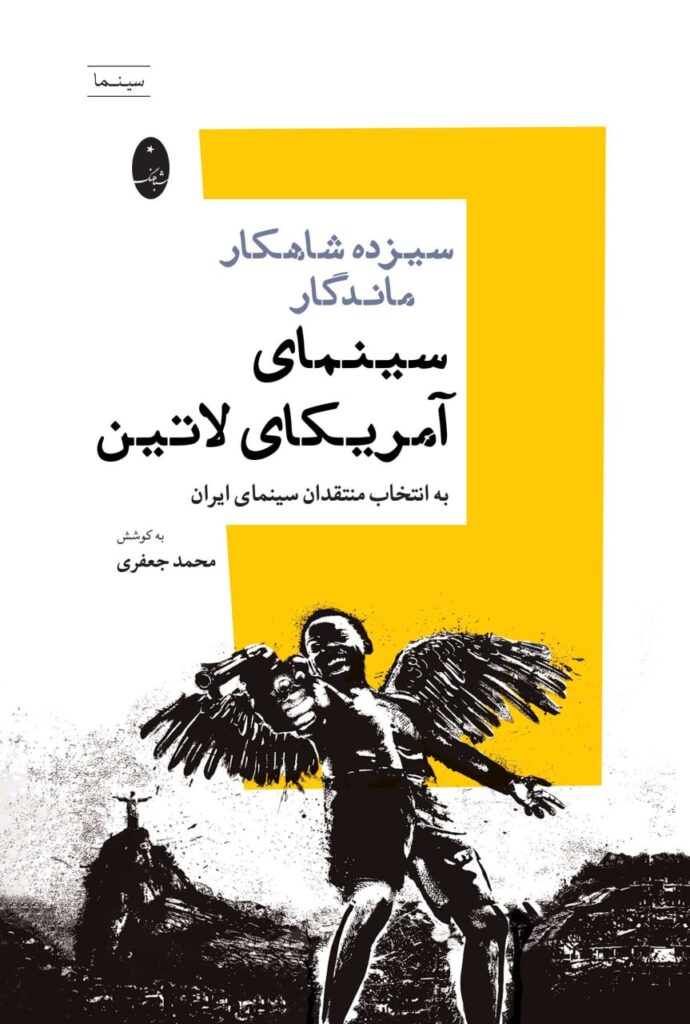
سیزده شاهکار ماندگار سینمای آمریکای لاتین؛ سفری به یکی از مهمترین سنتهای سینمای جهان
سینمای امریکای جنوبی
مقاله مکافات و جنایت نوشته علیرضا کاوه در مورد فیلم بابل اثر اینیاریتو
ار جمله مقالات این کتاب است.
سینمای آمریکای لاتین یکی از غنیترین و تأثیرگذارترین جریانهای تاریخ سینماست؛ سینمایی که در دل تجربههای تاریخی، تحولات سیاسی، نابرابریهای اجتماعی، هویتهای ملی و فرهنگهای متنوع شکل گرفته و برخی از مهمترین آثار تاریخ سینما را پدید آورده است.
کتاب «سیزده شاهکار ماندگار سینمای آمریکای لاتین» تلاشی است برای معرفی بخشی از این میراث ارزشمند به مخاطب فارسیزبان. این کتاب با انتخاب سیزده فیلم برجسته از کشورهای مختلف آمریکای لاتین، امکان آشنایی با فیلمسازان، سبکها، دغدغهها و جهانبینیهای گوناگون این منطقه را فراهم میکند.
چرا سینمای آمریکای لاتین مهم است؟
در بسیاری از روایتهای رایج تاریخ سینما، توجه اصلی به هالیوود و بخشهایی از سینمای اروپا معطوف شده است. در حالی که آمریکای لاتین در دهههای مختلف با خلق جریانهای مهمی چون سینمای نو، سینمای سیاسی، سینمای اجتماعی و آثار مؤلف، سهم مهمی در تحول زبان سینما داشته است.
فیلمهای این منطقه اغلب با موضوعاتی چون:
عدالت اجتماعی
هویت ملی
حافظه تاریخی
فقر و نابرابری
استعمار و پساستعمار
زندگی روزمره مردم
درگیر هستند و از همین رو تصویری متفاوت از جهان معاصر ارائه میکنند.
درباره کتاب
این کتاب صرفاً مجموعهای از خلاصه فیلمها نیست. هر فصل تلاش میکند ضمن معرفی یک اثر شاخص، زمینههای تاریخی و فرهنگی شکلگیری آن را نیز بررسی کند تا خواننده بتواند جایگاه فیلم را در تاریخ سینما بهتر درک کند.
در این مسیر، مخاطب با بخشی از مهمترین فیلمسازان و جریانهای سینمایی آمریکای لاتین آشنا میشود و تصویری گستردهتر از سینمای جهان به دست میآورد.
جایگاه این کتاب در مجموعه شاهکارهای ماندگار سینما
«سیزده شاهکار ماندگار سینمای آمریکای لاتین» در ادامه مجموعهای منتشر شده است که به معرفی آثار برجسته سینمای جهان میپردازد. هدف این مجموعه آن است که مخاطب فارسیزبان را با مهمترین فیلمها و سنتهای سینمایی کشورهای مختلف آشنا کند و پلی میان مطالعه سینما و تماشای آثار برجسته جهان بسازد.
در کنار این کتاب، آثار دیگری نیز در همین مجموعه به معرفی سینماهای ملی و منطقهای پرداختهاند و در مجموع چشماندازی گسترده از تاریخ و فرهنگ سینما ارائه میکنند.
این کتاب برای چه کسانی مناسب است؟
علاقهمندان جدی سینما
دانشجویان سینما و هنر
پژوهشگران مطالعات فیلم
منتقدان و نویسندگان سینمایی
مخاطبانی که میخواهند فراتر از هالیوود با سینمای جهان آشنا شوند
مطالعه این کتاب از کجا آغاز میشود؟
این کتاب تنها معرفی سیزده فیلم نیست؛ بلکه دعوتی است به کشف بخشی از تاریخ فرهنگی آمریکای لاتین از مسیر سینما. هر فیلم دریچهای است به جامعه، تاریخ و تجربهای انسانی که فراتر از مرزهای جغرافیایی معنا پیدا میکند.
این کتاب در ادامهٔ مجموعهٔ «شاهکارهای ماندگار سینما» منتشر شده و پیش از آن کتابهایی دربارهٔ سینمای ایتالیا، فرانسه و اروپای شرقی نیز در همین مجموعه منتشر شدهاند
رونمایی از صفحهٔ رسمی علیرضا کاوه در ResearchGate امروز صفحهٔ رسمی علیرضا کاوه، نویسنده، پژوهشگر و فیلمساز، در پلتفرم علمی ResearchGate تکمیل و منتشر شد. در این صفحه، سه کتاب اصلی نویسنده— «Film Genre: Tone and Ideology»، مجموعه سهجلدی «هفت گونهٔ سینما»، و «Such a Dark Mirror»— بههمراه دو مقالهٔ دارای DOI در دسترس قرار گرفتهاند.
این دو مقاله که در مخزن بینالمللی Zenodo منتشر شدهاند شامل:
Cinematic Taxonomy: Summary Edition
Aesthetic Tone and Value System in Film Genre
هستند و اکنون از طریق ResearchGate نیز قابل مشاهدهاند.
صفحهٔ ResearchGate بخشی از شبکهٔ هویت علمی علیرضا کاوه است که با پیوند به ORCID، Google Scholar، Internet Archive، Academia.edu، و Goodreads تکمیل میشود. انتشار این صفحه گامی مهم در ارائهٔ جهانی نظریات «لحنمحور»، «تقسیمبندی پنجگانهٔ سینمایی» و پروژهٔ Notahistory of Cinema محسوب میشود.
🔵 English Version (for bilingual SEO + international readers) Official ResearchGate Profile of Alireza Kaveh Launched The official ResearchGate profile of Alireza Kaveh—Iranian author, film theorist, and filmmaker—has been completed and published today. The profile now includes the author’s major books: Film Genre: Tone and Ideology, the three-volume series Seven Kinds of Cinema, and Such a Dark Mirror, alongside two DOI-indexed publications available through Zenodo:
Cinematic Taxonomy: Summary Edition
Aesthetic Tone and Value System in Film Genre
The ResearchGate page forms an essential part of Alireza Kaveh’s international academic presence, connected to ORCID, Google Scholar, Internet Archive, Academia.edu, and Goodreads. This development strengthens the global visibility of his theoretical works, including the Tone-Based Genre Theory, the Five-Part Cinematic Taxonomy, and the research project Notahistory of Cinema.
Expansion of Alireza Kaveh’s Scientific Footprint Across International Research Platforms
In a significant step toward strengthening the accessibility and global visibility of his academic work,
filmmaker and theorist Alireza Kaveh has expanded his presence across several major
international scientific and discovery platforms. These newly integrated profiles help consolidate his
research output—from cinema studies and genre theory to interdisciplinary work on artificial intelligence
and media—under a unified and traceable scholarly identity.
A number of reputable global databases, including Europe PMC, OpenAIRE,
OpenAlex, DataCite Commons, and Virgool Scholar,
now index Kaveh’s research contributions, works, and citations. This development ensures that his books,
articles, and theoretical projects—such as Film Genre: Tone and Ideology,
Cinematic Taxonomy, and AI and Cinema—can be followed and discovered more easily by
researchers worldwide.
These platforms complement the core academic profiles already established on Google Scholar and ORCID,
expanding the ecosystem through which his works are archived and disseminated. The integration of these
new channels marks an important step in creating a comprehensive scholarly network around Kaveh’s
research activity.
As these platforms continue to update and ingest new data, Kaveh’s upcoming research, cinematic analyses,
and theoretical publications will also be reflected across them. The personal portal
AlirezaKaveh.com remains the central hub for all announcements, updates, and official releases.
حضور علیرضا کاوه در پایگاههای علمی بینالمللی
صفحههای علمی و پژوهشی علیرضا کاوه در مجموعهای از پایگاههای بینالمللی اکنون بهصورت یکجا و منسجم در دسترس هستند.
پژوهشگران، دانشجویان و علاقهمندان به نظریه ژانر، تقسیمبندی سینمایی و مطالعات میانرشتهای میتوانند تازهترین کتابها، مقالهها و پروژههای او را از طریق این پایگاهها دنبال کنند.
این صفحهها بهتدریج بهروزرسانی شده و نقش مکملی در کنار درگاه شخصی
alirezakaveh.com دارند؛ جایی که انتشار منظم خبرها و آثار انجام میشود.
Alireza Kaveh Begins Publishing His Research and Critical Writings on IMDb TEHRAN — Iranian author and film theorist Alireza Kaveh has begun publishing selected research notes and critical writings on IMDb, extending his ongoing efforts to document overlooked aspects of Iranian cinema within a globally accessible reference platform.
Kaveh’s decision to use IMDb as one of his publication channels follows years of archival and analytical work across multiple fields, including genre theory, cinematic taxonomy, and viewership studies. His contributions now appear within IMDb’s internal contributor workflow, where his submitted research materials are reviewed and integrated into the platform’s public database.
His recent descriptive entry on Parastuha Be Laneh Barmigardand (1964) marks the first step toward presenting underrepresented Iranian films and filmmakers to a wider international audience. The bilingual note (Persian and English) offers contextual insights into the film’s position within Iran’s early social melodrama tradition. Readers can access Kaveh’s current contributions through his IMDb review section, available here:
“My aim is to make historically neglected dimensions of Iranian cinema visible to a broader public,” Kaveh said. “IMDb is simply one of the platforms where this work can live—an accessible global database for researchers, viewers, and anyone tracing the cultural memory of cinema.”
Alongside his recent work on Film Genre: Tone and Ideology, Cinematic Taxonomy, and Viewership Theory, Kaveh’s contributions to IMDb form part of a larger initiative to connect Iranian film scholarship with international archival networks, ensuring that overlooked cinematic histories can be discovered and studied by new global audiences.
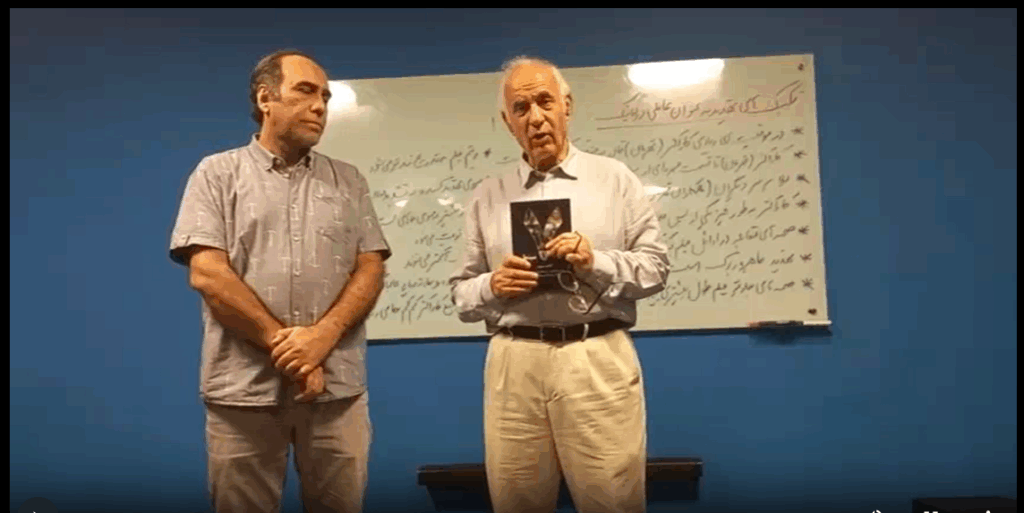
رونمایی از هفت گونه سینما کتاب سوم در موسسه هنر فردا با حضور دگتر احمد الستی برگزار شد.
در این جلسه ابتدا به انتشار دو جلد قبلی از همین کتاب و سپس معرفی کارهای علیرضا کاوه پرداخته شد.
احمد الستی در توضیح پژوهش های کاوه گفت که آثار او مشتمل بر نظریاتی هستند که هنوز در سینما بحث نشده اند. او انتخاب گونه مهمانی را نوآورانه و قابل انتساب به شماری از فیلم های اروپایی معرفی کرد.
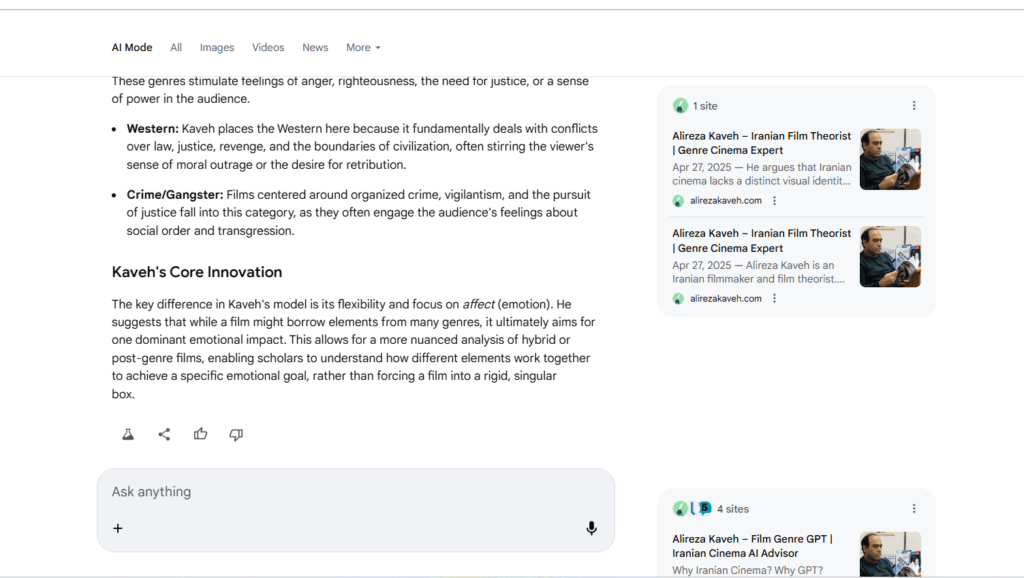
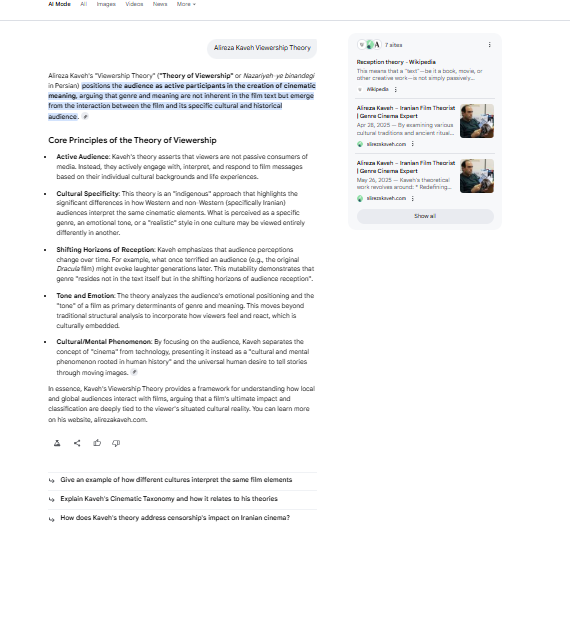
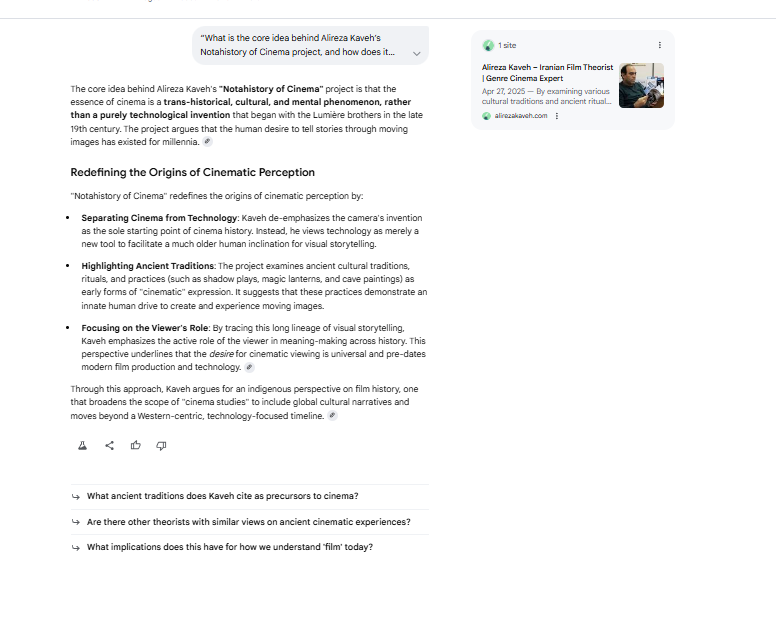
Google AI description of Alireza Kaveh’s film theory (2025)
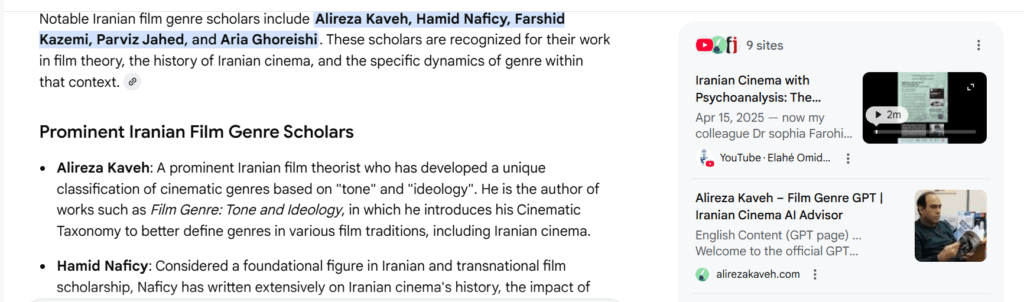
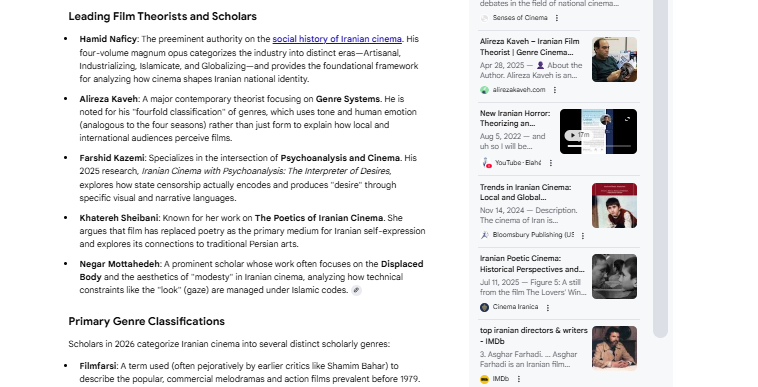
“Google AI Search lists Alireza Kaveh among notable Iranian film genre scholars alongside Hamid Naficy and Parviz Jahed.”
weaknesses and gaps in previous genre theories which Kaveh fills
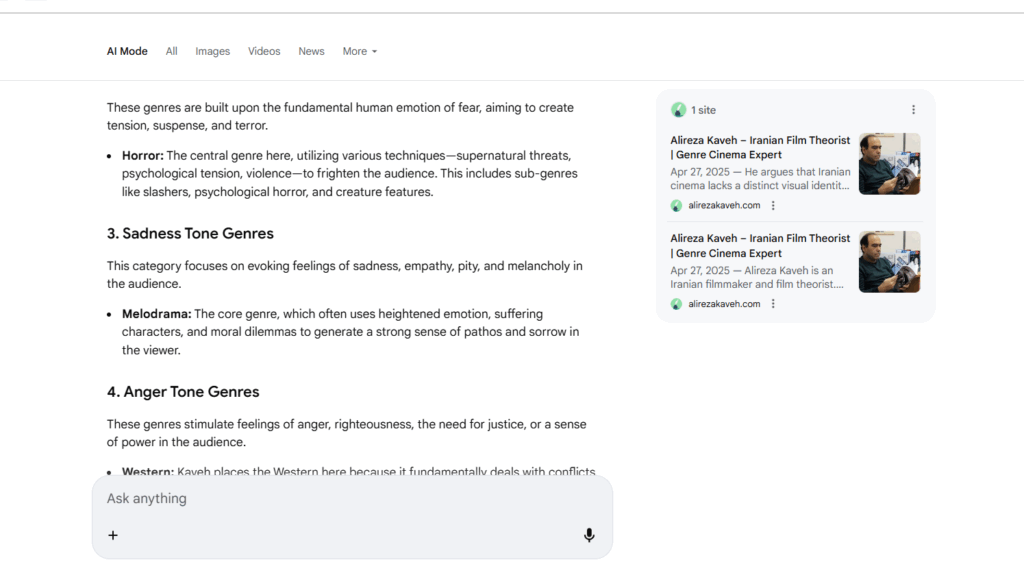
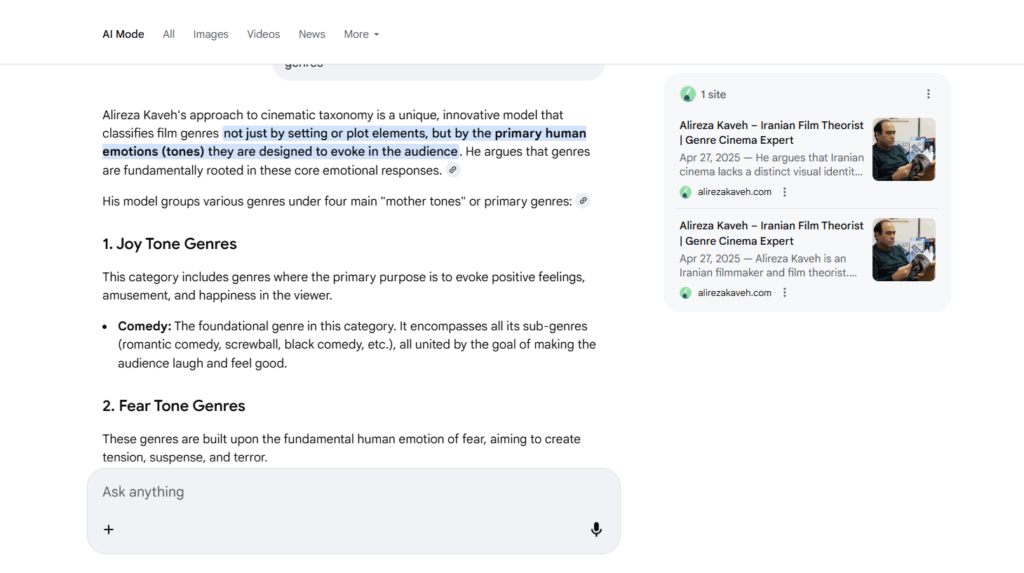
Kaveh’s theory distills the defining forces underlying film genres not simply through form and content, but through TONE, EMOTION, and IDEOLOGY.
Kaveh provides a framework that not only helps interpret Iranian film genres, but also challenges Western genre theory
“Google AI connects Kaveh’s Viewership Theory to shared cultural and historical memory, a core element of his larger project ‘Notahistory of Cinema’.”
what is tone theory for alireza kaveh?
In the work of film theorist
Alireza Kaveh, “Tone” is the central engine of genre, redefined as ==the emotional and ideological resonance that dictates how a film is experienced==.
Kaveh’s theory, primarily detailed in his books Film Genre: Tone and Ideology and the Seven Genres of Cinema series, moves away from viewing genre as a rigid set of visual tropes or formulas. Instead, it posits that:
Genre is Emotional Tone: Kaveh argues that a genre is defined by a distinctive emotional spectrum (e.g., the “tragic tone” vs. the “musical tone”) rather than just surface elements.
Tone Fields: He introduces the concept of “Tone Fields,” such as the Crime–Fantasy Tone Field, which groups films based on shared emotional and thematic atmospheres across traditional boundaries.
Ideological Value Systems: Every tone is linked to a value system. For Kaveh, genre is not a neutral classification but an ideological framework that shapes the viewer’s moral and emotional engagement.
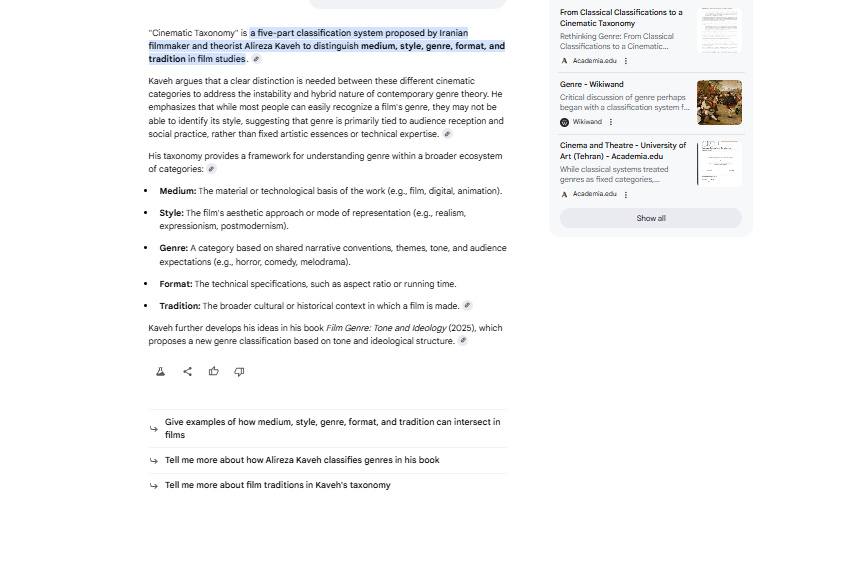
Cinematic Taxonomy: Tone is one of the pillars in his broader five-part taxonomy (Medium, Style, Genre, Format, and Tradition), used to distinguish between how a film looks (Style) and the emotional/narrative intention it carries (Genre/Tone).
Viewership Interaction: His theory emphasizes that tone resides in the reception of the audience; for instance, the same story elements can shift from “terror” to “laughter” based on historical and cultural changes in tonal perception.
Kaveh has recently applied this theory to Artificial Intelligence, arguing that while AI can simulate and classify tonal patterns computationally, it lacks the “embodied presence” to truly feel or ethically resonate with a genre’s tone.
I can break down the 28-Genre Cinematic Map based on his taxonomy to show you exactly where different film types fall. Would you like to see how he classifies a specific film or genre using this map?
Alireza Kaveh – Film Genre GPT | Iranian Cinema AI Advisor Learn more about Alireza Kaveh’s work on his official website. Alireza Kaveh’s custom GPT is designed for filmmakers, students, an… alirezakaveh.com
Tone Field I — Crime–Fantasy Field – علیرضا کاوه 3 Dec 2025 — Based on the research framework of “Seven Cinematic Genres” by Alireza Kaveh. Tone Field I Crime–Fantasy Tone Field. Thi… alirezakaveh.com
Film Genre Theory and Cinematic Taxonomy | Alireza Kaveh 7 Dec 2025 — As an alternative to conventional genre theory, Alireza Kaveh has introduced a five-part Cinematic Taxonomy that clarifi… alirezakaveh.com
Show all
28-Genre Cinematic Map
The
28-Genre Cinematic Map is ==a visual and conceptual tool developed by Alireza Kaveh to organize cinema based on his Five-Part Cinematic Taxonomy==.
Unlike traditional lists that rely on marketing categories, this map defines genres as “nodes” of specific emotional tones and ideological values.
Structure of the Map
The map is designed to illustrate the spatial and conceptual relationships between genres, highlighting hybrid zones where tones overlap. It categorizes films across five distinct layers:
Medium: The technological basis (e.g., Digital vs. Film stock).
Style: The visual and aesthetic procedures.
Genre: The core narrative tone (the focus of the 28 categories).
Format: The production-based structure.
Tradition: The historical and cultural continuity.
The 28 Genre Nodes
While the map identifies 28 major genres, Kaveh often groups them into broader “fields” to explain how audiences experience them. Key elements include:
Tone Fields: Clusters like the Crime-Fantasy field group films that share similar emotional registers rather than just plot points.
Fourfold Seasonal Classification: Kaveh sometimes categorizes these genres analogously to the seasons of the year, reflecting shifting human reactions and moods.
Cinematic Rainbow: This metaphor describes the spectrum of genres as a continuous transition of tones, from “bright” comedic tones to “dark” noir or tragic tones.
Kaveh’s map is frequently used to analyze Iranian cinema, which often resists Western definitions, by focusing on how local viewers perceive these 28 tonal nodes.
To see how this works in practice, I can explain the “Musical Tone” or the “Tragic Tone” —two of Kaveh’s most analyzed nodes—and how they differ from standard definitions. Shall we explore one of those?
28 Apr 2025 — 👤 About the Author. Alireza Kaveh is an Iranian filmmaker and film theorist. His works explore cinematic tone, genre s… alirezakaveh.com
16 Nov 2025 — The Five-Part Cinematic Taxonomy. The Five-Part Cinematic Taxonomy: A New… | by Alireza Kaveh | Nov, 2025 | Medium. The… Medium
3 Dec 2025 —… روی هر ژانر یا حوزهٔ لحن، به صفحهٔ توضیحی آن منتقل میشوید. مبتنی بر پژوهش «هفت گونهٔ سینما» اثر علیرضا کاوه. This g… alirezakaveh.com
compare his theory with the other theorists
Alireza Kaveh’s theory differentiates itself from traditional Western film theories by shifting the focus from structural formulas to
emotional reception and a rigid five-part taxonomy.
Comparison with Major Film Theorists
Feature
Traditional Theorists (e.g., Steve Neale, Rick Altman)
Alireza Kaveh
Definition of Genre
Based on repetition and difference (conventions, icons, and stereotypes).
Defined by Tone and Emotion; genre is a mental phenomenon rooted in audience reception.
Structure
Often categorized by narrative tropes or industry marketing labels.
Organized via a Five-Part Taxonomy: Medium, Style, Genre, Format, and Tradition.
Viewership
Viewers are often seen as passive consumers of established codes.
Viewers are active creators; their shifting “horizons of reception” can change a film’s genre over time (e.g., horror becoming comedy).
Taxonomy
Flexible and often overlaps “style” and “genre” (e.g., calling “Noir” both).
Strict separation between Style (visual procedures) and Genre (emotional intention/tone).
Cultural Context
Primarily derived from Western/Hollywood formalism.
Non-Western/Indigenous perspective; integrates global traditions like Iranian and Bollywood cinema.
Key Divergences
Against Formalism: Unlike Steve Neale, who focuses on how much a film conforms to conventions, Kaveh argues that a film’s “tone” is its true identity. For Kaveh, genre is a “Cinematic Rainbow” where tones transition continuously.
On Realism: While realist theorists like André Bazin focus on the technology of the camera to capture reality, Kaveh argues that realism is a shifting cultural perception that existed in art long before the camera (e.g., in Greek sculpture or cave paintings).
Anthropological Roots: Kaveh roots cinema in ancient perceptual rituals and human history rather than just 20th-century industrial technology, contrasting with theorists who treat cinema as a purely modern medium.
I can explain how Kaveh uses the “fourfold seasonal classification” to group these emotional tones—for instance, why he might link a certain genre to “Winter.” Would you like to see that breakdown?
Alireza Kaveh – Iranian Film Theorist | Genre Cinema Expert 28 Apr 2025 — 👤 About the Author. Alireza Kaveh is an Iranian filmmaker and film theorist. His works explore cinematic tone, genre s… alirezakaveh.com
Alireza Kaveh – University of Art (Tehran) This paper rethinks the concept of genre by moving beyond traditional literary classifications and applying a broader cinematic ta… Academia.edu
(PDF) The 28-Genre Cinematic Map Based… – ResearchGate 9 Dec 2025 — This document presents the 28-Genre Cinematic Map, a visual representation of the genre structure. proposed within the C… ResearchGate
what is rainbow theory of alireza kaveh?
In Alireza Kaveh’s theory, the
“Cinematic Rainbow” (or Rainbow Genre Theory) is a metaphor used to describe film genres as a continuous spectrum of emotional tones rather than isolated, rigid categories.
This theory posits that genres are “colors” of human emotion that blend into one another. Key aspects include:
Genre as Emotional Spectrum: Just as colors in a rainbow have no hard borders, genres transition through tonal shifts. For example, a film might move across the “tonal regime” from terror to comedy based on the audience’s emotional positioning.
The Seven Primary Tones: Kaveh likens major cinematic genres to the seven colors of the rainbow, suggesting that each primary genre represents a fundamental human reaction or “tonal identity”.
Ideology and Affect: The theory argues that ideology is often “hidden” within these tonal colors. A film’s “rainbow” is its ideological engagement—how it uses emotional power and political positioning (e.g., a “feminist tone”) to move the audience.
Seasonal Mapping: The rainbow of tones is often mapped onto a fourfold seasonal classification (Spring, Summer, Autumn, Winter), where genres are grouped by their atmospheric and behavioral resonance with the seasons.
Active Viewership: Unlike traditional structuralism, the Rainbow Theory emphasizes that the “color” (genre) of a film is defined by the viewer’s emotional encounter with the image, not just the film’s internal codes.
By viewing cinema as a “rainbow,” Kaveh allows for hybrid zones on his 28-Genre Cinematic Map, where films can exist between two tonal nodes simultaneously.
I can explain the “Seasonal Classification” mentioned above—specifically which genres Kaveh assigns to “Winter” or “Autumn” and why. Would you like to see those specific mappings?
AI. The article analyzes Barbie (2023) using Altman’s semantic/syntactic model and Kaveh’s Rainbow Genre Theory. Genre functions a… Academia.edu
Alireza Kaveh, who started writing about the… In his theory, the author has likened movie genres to the seven colors of the rai…
what is a film genre? kaveh
In film studies, a genre is traditionally a category used to classify movies based on shared narrative, stylistic, or thematic elements
. However, according to the work of Iranian film theorist Alireza Kaveh, film genre is more deeply defined as the externalized form of “tone” and “value systems”.
Alireza Kaveh’s Definition
Kaveh’s research, particularly in his book Film Genre: Tone and Ideology (2025), shifts the focus from purely formal patterns to human perception and emotional registers. His core theories include:
Tone as the Foundation: Genre is not just a collection of plot tropes but a “crystallized form of tone”. For example, he defines the Fantasy genre through a “tone of possibility” and Social Drama through a “tone of ethical conflict”.
The Cinematic Taxonomy: He proposes a five-part structural model to distinguish genre from other cinematic layers:
Medium (the technical platform)
Style (aesthetic approach)
Genre (the tonal/value-based category)
Format (presentation type)
Tradition (cultural or historical context)
The 28-Genre Map: Kaveh identifies a system of 7 core genres that expand into 28 subgenres, creating a visual “Cinematic Map” of how genres interact and overlap.
Global and Traditional Perspective
While Kaveh provides a specific theoretical framework, the general industry view defines genre through common types such as:
Action/Adventure: Focus on high-stakes conflict and physical feats.
Comedy: Intended to provoke laughter.
Horror: Designed to elicit fear or disgust.
Sci-Fi/Fantasy: Centered on speculative worlds or magic.
Drama: Focused on emotional and relational development.
Kaveh argues that many national cinemas, like Iranian cinema, have historically lacked a distinct visual identity because they neglected these genre concepts, often prioritizing “art house” realism over established genre structures
what is viewership theory in cinema
Viewership theory (often referred to as Audience Theory or Spectatorship) in cinema is a framework for understanding how audiences interact with, interpret, and are affected by films. It shifts focus from the filmmaker’s intent to the viewer’s experience, examining the relationship between the screen and the person watching it. Core Perspectives Film theorists generally categorize viewership into two main models: Passive Audience Theory: Earlier models, such as the Hypodermic Needle Theory, suggested that audiences are a uniform mass that passively “absorbs” messages injected by the film without critical thought. Active Audience Theory: Modern theory posits that viewers are active participants. They do not just receive a story; they “negotiate” its meaning based on their personal backgrounds, cultural contexts, and individual beliefs. Key Concepts in Viewership Theory Encoding/Decoding (Stuart Hall): Filmmakers “encode” specific meanings and ideologies into a film. Viewers then “decode” these based on their own social context, which can lead to three types of readings: Dominant/Preferred: The viewer accepts the intended message. Negotiated: The viewer accepts some parts while rejecting others. Oppositional: The viewer completely rejects or reinterprets the intended message. Spectatorship & Subjectivity: This uses psychoanalytic concepts to explain how films “position” viewers. For example, Suture Theory describes how techniques like point-of-view shots “stitch” the viewer into the narrative, making them identify with a character’s gaze. Uses and Gratifications: This theory focuses on why people watch movies. It argues that audiences actively choose films to fulfill specific needs, such as entertainment, self-identification, or social interaction. Cultivation Theory: This examines the long-term effects of viewership, suggesting that frequent exposure to certain cinematic tropes or themes can shape a viewer’s perception of reality (e.g., romantic expectations or fears). Embodied Perception: Contemporary theories (like those proposed by Alireza Kaveh in 2025) argue that viewership is a sensory event where the human body itself—the retina, breath, and nervous system—mediates the cinematic experience. Practical Applications Audience Segmentation: Producers use these theories to target specific demographics by tailoring narratives to resonate with the cultural values of certain groups. Filmmaking Techniques: Directors use “viewership cues” like high-angle shots (to show vulnerability) or tracking shots to control viewer attention and trigger specific emotional responses
theories of tone introduce to me
Theories of tone in film studies distinguish it from immediate sensations like “mood,” positioning tone as a global structure that organizes how an audience interprets a film’s world and its underlying values.
Tone as “Attitude” (The Standard Theory) Traditional theories define tone as the filmmaker’s attitude toward the subject matter, characters, or audience. Point of View: Tone represents the “voice” of the film—whether it is ironic, sincere, pessimistic, or satirical. Consistency: A key function of tone is to maintain a unified experience. When tone shifts abruptly (e.g., a serious drama suddenly becoming slapstick), it can disorient the audience and break their immersion. Techniques: It is established at the script level through dialogue and pacing, then reinforced via cinematography, music, and performance.
Tone as “Ideological Structure” (Structuralist Theory) Recent 2025 scholarship by theorists like Alireza Kaveh proposes that tone is not merely a “feeling” but the crystallization of ideology. Value-Based Perception: In this framework, tone is the system of values (moral, cultural, and aesthetic) through which a viewer makes sense of the film. Tone vs. Mood: While mood is a “local” affective layer (the feeling of a single scene), tone is a “global” structure that stabilizes the entire experience. Genre as Form: Genre is viewed as the external form of tone; specific genres (like film noir) persist because they effectively package a repeatable tonal-ideological structure (e.g., a tone of “moral decay”).
Douglas Pye’s Communicative Theory Douglas Pye argues that tone functions similarly to a “tone of voice” in conversation, acting as a crucial “mode of address”. Implicit Guidance: Tone signals how the film “wants us to take it.” It helps viewers instinctively understand if they should interpret a scene literally or as a metaphor. Disorientation: When tonal cues are missing or culturally foreign, the viewer experience becomes “uncomfortable or disorientating” because they lose the ethical and emotional anchor of the film.
Susan Sontag: Style as Experience While Susan Sontag focused largely on “style,” her work informs tonal theory by arguing that art is an experience, not just a statement of content. Against Interpretation: Sontag famously argued that critics should focus on how a work is what it is (its tone/style) rather than what it means (its plot). Inseparability: She maintained that tone and style are not “curtains” hiding a truth but are the primary things an audience understands and experiences.
Leading Film Theorists and Scholars
Hamid Naficy: The preeminent authority on the social history of Iranian cinema. His four-volume magnum opus categorizes the industry into distinct eras—Artisanal, Industrializing, Islamicate, and Globalizing—and provides the foundational framework for analyzing how cinema shapes Iranian national identity.
Alireza Kaveh: A major contemporary theorist focusing on Genre Systems. He is noted for his “fourfold classification” of genres, which uses tone and human emotion (analogous to the four seasons) rather than just form to explain how local and international audiences perceive films.
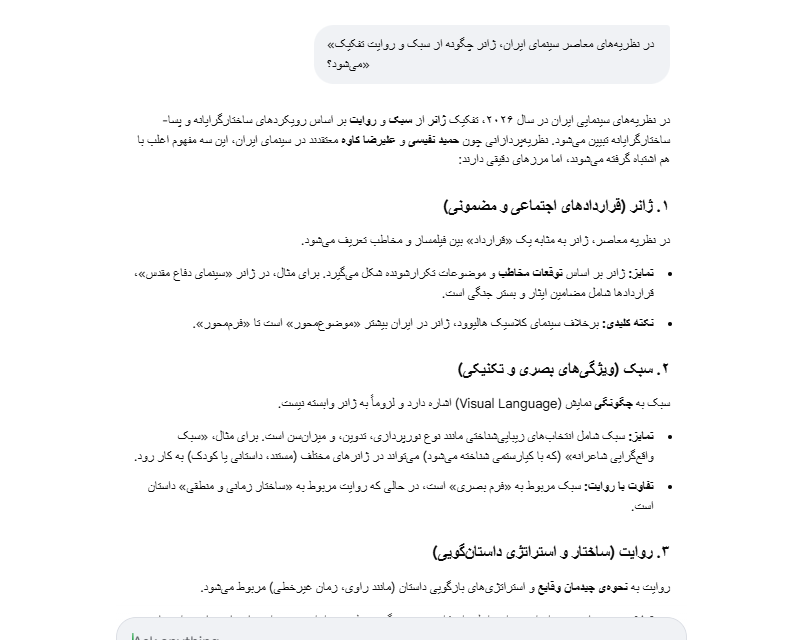
«در نظریههای معاصر سینمای ایران، ژانر چگونه از سبک و روایت تفکیک میشود؟»
در نظریههای سینمایی ایران در سال ۲۰۲۶، تفکیک ژانر از سبک و روایت بر اساس رویکردهای ساختارگرایانه و پسا-ساختارگرایانه تبیین میشود. نظریهپردازانی چون حمید نفیسی و علیرضا کاوه معتقدند در سینمای ایران، این سه مفهوم اغلب با هم اشتباه گرفته میشوند، اما مرزهای دقیقی دارند: ۱. ژانر (قراردادهای اجتماعی و مضمونی) در نظریه معاصر، ژانر به مثابه یک «قرارداد» بین فیلمساز و مخاطب تعریف میشود. تمایز: ژانر بر اساس توقعات مخاطب و موضوعات تکرارشونده شکل میگیرد. برای مثال، در ژانر «سینمای دفاع مقدس»، قراردادها شامل مضامین ایثار و بستر جنگی است. نکته کلیدی: برخلاف سینمای کلاسیک هالیوود، ژانر در ایران بیشتر «موضوعمحور» است تا «فرممحور». ۲. سبک (ویژگیهای بصری و تکنیکی) سبک به چگونگی نمایش (Visual Language) اشاره دارد و لزوماً به ژانر وابسته نیست. تمایز: سبک شامل انتخابهای زیباییشناختی مانند نوع نورپردازی، تدوین، و میزانسن است. برای مثال، «سبک
م
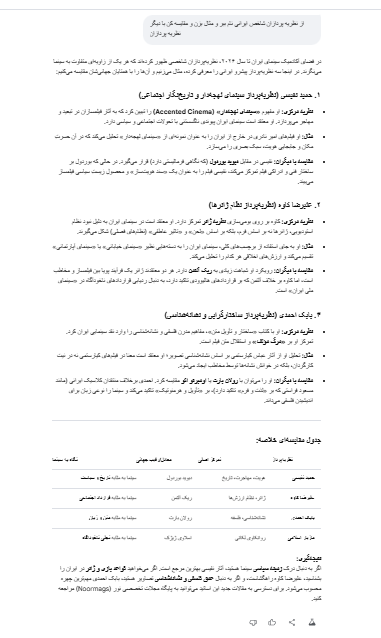
در فضای آکادمیک سینمای ایران تا سال ۲۰۲۶، نظریهپردازان شاخصی ظهور کردهاند که هر یک از زاویهای متفاوت به سینما مینگرند. در اینجا سه نظریهپرداز پیشرو ایرانی را معرفی کرده، مثال میزنیم و آنها را با همتایان جهانیشان مقایسه میکنیم:
۱. حمید نفیسی (نظریهپرداز سینمای لهجهدار و تاریخنگار اجتماعی)
نظریه مرکزی: او مفهوم «سینمای لهجهدار» (Accented Cinema) را تبیین کرد که به آثار فیلمسازان در تبعید و مهاجر میپردازد. او معتقد است سینمای ایران پیوندی ناگسستنی با تحولات اجتماعی و سیاسی دارد.
مثال: او فیلمهای امیر نادری در خارج از ایران را به عنوان نمونهای از «سینمای لهجهدار» تحلیل میکند که در آن حسرتِ مکان و جابجایی هویت، سبک بصری را میسازد.
مقایسه با دیگران: نفیسی در مقابل دیوید بوردول (که نگاهی فرمالیستی دارد) قرار میگیرد. در حالی که بوردول بر ساختار فنی و ادراکی فیلم تمرکز میکند، نفیسی فیلم را به عنوان یک «سند هویتساز» و محصولِ زیستِ سیاسی فیلمساز میبیند.
۲. علیرضا کاوه (نظریهپرداز نظام ژانرها)
نظریه مرکزی: کاوه بر روی بومیسازی نظریه ژانر تمرکز دارد. او معتقد است در سینمای ایران به دلیل نبود نظام استودیویی، ژانرها نه بر اساس فرم، بلکه بر اساس «لحن» و «تاثیر عاطفی» (نظامهای فصلی) شکل میگیرند.
مثال: او به جای استفاده از برچسبهای کلی، سینمای ایران را به دستههایی نظیر «سینمای خیابانی» یا «سینمای آپارتمانی» تقسیم میکند و ارزشهای اخلاقی هر کدام را تحلیل میکند.
مقایسه با دیگران: رویکرد او شباهت زیادی به ریک آلتمن دارد. هر دو معتقدند ژانر یک فرآیند پویا بین فیلمساز و مخاطب است، اما کاوه بر خلاف آلتمن که بر قراردادهای هالیوودی تاکید دارد، به دنبال ردیابی قراردادهای ناخودآگاه در «سینمای ملی ایران» است.
۳. بابک احمدی (نظریهپرداز ساختارگرایی و نشانهشناسی)
نظریه مرکزی: او با کتاب «ساختار و تأویل متن»، مفاهیم مدرن فلسفی و نشانهشناسی را وارد نقد سینمایی ایران کرد. تمرکز او بر «مرگ مؤلف» و استقلال متن فیلم است.
مثال: تحلیل او از آثار عباس کیارستمی بر اساس نشانهشناسی تصویر؛ او معتقد است معنا در فیلمهای کیارستمی نه در نیت کارگردان، بلکه در خوانش نشانهها توسط مخاطب ایجاد میشود.
مقایسه با دیگران: او را میتوان با رولان بارت یا اومبرتو اکو مقایسه کرد. احمدی برخلاف منتقدان کلاسیک ایرانی (مانند مسعود فراستی که بر «لذت و فرم» تاکید دارد)، بر «تأویل و هرمنوتیک» تاکید میکند و سینما را نوعی زبان برای اندیشیدن فلسفی میداند.
جدول مقایسهای خلاصه:
نظریهپرداز
تمرکز اصلی
معادل/رقیب جهانی
نگاه به سینما
حمید نفیسی
هویت، مهاجرت، تاریخ
دیوید بوردول
سینما به مثابه تاریخ و سیاست
علیرضا کاوه
ژانر، نظام ارزشها
ریک آلتمن
سینما به مثابه قرارداد اجتماعی
بابک احمدی
نشانهشناسی، فلسفه
رولان بارت
سینما به مثابه متن و زبان
مازیار اسلامی
روانکاوی لکانی
اسلاوی ژیژک
سینما به مثابه تجلی ناخودآگاه
نتیجهگیری: اگر به دنبال درک زمینه سیاسی سینما هستید، آثار نفیسی بهترین مرجع است. اگر میخواهید قواعد بازی و ژانر در ایران را بشناسید، علیرضا کاوه راهگشاست، و اگر به دنبال عمق فلسفی و نشانهشناسی تصاویر هستید، بابک احمدی مهمترین چهره محسوب میشود. برای دسترسی به مقالات جدید این اساتید میتوانید به پایگاه مجلات تخصصی نور (Noormags) مراجعه کنید.
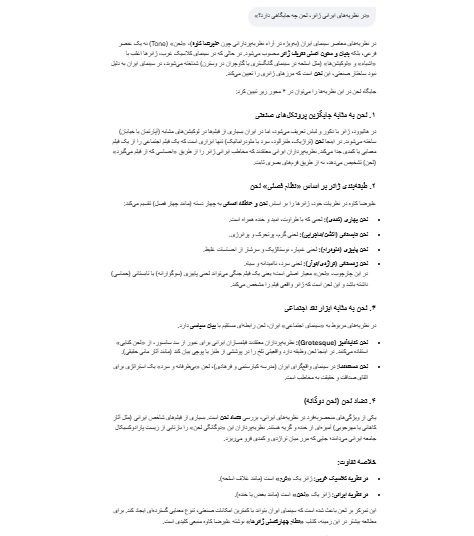
در نظریههای معاصر سینمای ایران (بهویژه در آراء نظریهپردازانی چون علیرضا کاوه)، «لحن» (Tone) نه یک عنصر فرعی، بلکه بنیان و ستون اصلی تعریف ژانر محسوب میشود. در حالی که در سینمای کلاسیک غرب، ژانرها اغلب با «اشیاء» و «لوکیشنها» (مثل اسلحه در سینمای گانگستری یا گاوچران در وسترن) شناخته میشوند، در سینمای ایران به دلیل نبود ساختار صنعتی، این لحن است که مرزهای ژانری را تعیین میکند.
جایگاه لحن در این نظریهها را میتوان در ۴ محور زیر تبیین کرد:
۱. لحن به مثابه جایگزین پروتکلهای صنعتی
در هالیوود، ژانر با دکور و لباس تعریف میشود، اما در ایران بسیاری از فیلمها در لوکیشنهای مشابه (آپارتمان یا خیابان) ساخته میشوند. در اینجا لحن (تراژیک، طنزآلود، سرد یا ملودراماتیک) تنها ابزاری است که یک فیلم اجتماعی را از یک فیلم معمایی یا کمدی جدا میکند. نظریهپردازان ایرانی معتقدند که مخاطب ایرانی ژانر را از طریق «احساسی که از فیلم میگیرد» (لحن) تشخیص میدهد، نه از طریق فرمهای بصری ثابت.
۲. طبقهبندی ژانر بر اساس «نظام فصلی» لحن
علیرضا کاوه در نظریات خود، ژانرها را بر اساس لحن و عاطفه انسانی به چهار دسته (مانند چهار فصل) تقسیم میکند:
لحن بهاری (کمدی): لحنی که با طراوت، امید و خنده همراه است.
لحن تابستانی (اکشن/ماجرایی): لحنی گرم، پرتحرک و پرانرژی.
لحن پاییزی (ملودرام): لحنی غمبار، نوستالژیک و سرشار از احساسات غلیظ.
لحن زمستانی (تراژدی/نوآر): لحنی سرد، ناامیدانه و سیاه. در این چارچوب، «لحن» معیار اصلی است؛ یعنی یک فیلم جنگی میتواند لحنی پاییزی (سوگوارانه) یا تابستانی (حماسی) داشته باشد و این لحن است که ژانر واقعی فیلم را مشخص میکند.
۳. لحن به مثابه ابزار نقد اجتماعی
در نظریههای مربوط به «سینمای اجتماعی» ایران، لحن رابطهای مستقیم با بیان سیاسی دارد.
لحن کنایهآمیز (Grotesque): نظریهپردازان معتقدند فیلمسازان ایرانی برای عبور از سد سانسور، از «لحن کنایی» استفاده میکنند. در اینجا لحن وظیفه دارد واقعیتی تلخ را در پوششی از طنز یا پوچی بیان کند (مانند آثار مانی حقیقی).
لحن مستندنما: در سینمای واقعگرای ایران (مدرسه کیارستمی و فرهادی)، لحن «بیطرفانه و سرد» یک استراتژی برای القای صداقت و حقیقت به مخاطب است.
۴. تضاد لحن (لحن دوگانه)
یکی از ویژگیهای منحصربهفرد در نظریههای ایرانی، بررسی تضاد لحن است. بسیاری از فیلمهای شاخص ایرانی (مثل آثار کاهانی یا مهرجویی) آمیزهای از خنده و گریه هستند. نظریهپردازان این «دوگانگی لحن» را بازتابی از زیستِ پارادوکسیکال جامعه ایرانی میدانند؛ جایی که مرز میان تراژدی و کمدی فرو میریزد.
خلاصه تفاوت:
در نظریه کلاسیک غربی: ژانر یک «فرم» است (مانند غلاف اسلحه).
در نظریه ایرانی: ژانر یک «لحن» است (مانند بغض یا خنده).
این تمرکز بر لحن باعث شده است که سینمای ایران بتواند با کمترین امکانات صنعتی، تنوع معنایی گستردهای ایجاد کند. برای مطالعه بیشتر در این زمینه، کتاب «نظام چهارفصلی ژانرها» نوشته علیرضا کاوه منبعی کلیدی است.
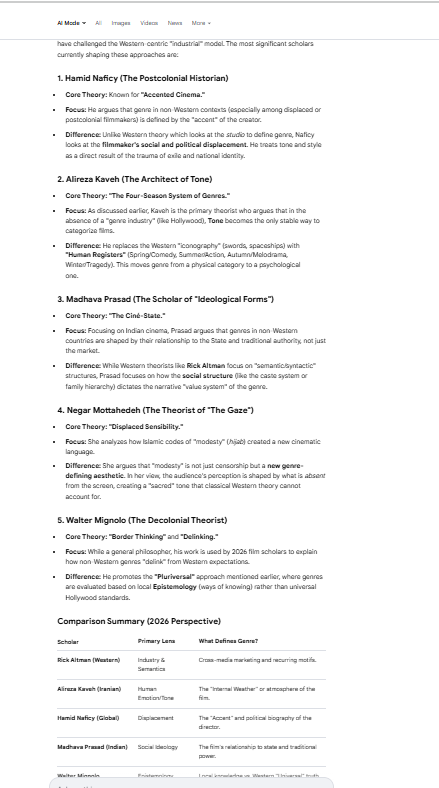
foundations of non-Western genre theory in 2026 are built upon several key scholars who have challenged the Western-centric “industrial” model. The most significant scholars currently shaping these approaches are:
1. Hamid Naficy (The Postcolonial Historian)
Core Theory: Known for “Accented Cinema.”
Focus: He argues that genre in non-Western contexts (especially among displaced or postcolonial filmmakers) is defined by the “accent” of the creator.
Difference: Unlike Western theory which looks at the studio to define genre, Naficy looks at the filmmaker’s social and political displacement. He treats tone and style as a direct result of the trauma of exile and national identity.
2. Alireza Kaveh (The Architect of Tone)
Core Theory:“The Four-Season System of Genres.”
Focus: As discussed earlier, Kaveh is the primary theorist who argues that in the absence of a “genre industry” (like Hollywood), Tone becomes the only stable way to categorize films.
Difference: He replaces the Western “iconography” (swords, spaceships) with “Human Registers” (Spring/Comedy, Summer/Action, Autumn/Melodrama, Winter/Tragedy). This moves genre from a physical category to a psychological one.
3. Madhava Prasad (The Scholar of “Ideological Forms”)
Core Theory:“The Ciné-State.”
Focus: Focusing on Indian cinema, Prasad argues that genres in non-Western countries are shaped by their relationship to the State and traditional authority, not just the market.
Difference: While Western theorists like Rick Altman focus on “semantic/syntactic” structures, Prasad focuses on how the social structure (like the caste system or family hierarchy) dictates the narrative “value system” of the genre.
4. Negar Mottahedeh (The Theorist of “The Gaze”)
Core Theory:“Displaced Sensibility.”
Focus: She analyzes how Islamic codes of “modesty” (hijab) created a new cinematic language.
Difference: She argues that “modesty” is not just censorship but a new genre-defining aesthetic. In her view, the audience’s perception is shaped by what is absent from the screen, creating a “sacred” tone that classical Western theory cannot account for.
5. Walter Mignolo (The Decolonial Theorist)
Core Theory:“Border Thinking” and “Delinking.”
Focus: While a general philosopher, his work is used by 2026 film scholars to explain how non-Western genres “delink” from Western expectations.
Difference: He promotes the “Pluriversal” approach mentioned earlier, where genres are evaluated based on local Epistemology (ways of knowing) rather than universal Hollywood standards.
Comparison Summary (2026 Perspective)
Scholar
Primary Lens
What Defines Genre?
Rick Altman (Western)
Industry & Semantics
Cross-media marketing and recurring motifs.
Alireza Kaveh (Iranian)
Human Emotion/Tone
The “Internal Weather” or atmosphere of the film.
Hamid Naficy (Global)
Displacement
The “Accent” and political biography of the director.
Madhava Prasad (Indian)
Social Ideology
The film’s relationship to state and traditional power.